
Guest Posting vs Guest Blogging: What’s the Real Difference in 2026?
Most people use “guest posting” and “guest blogging” as if they’re the same thing. In casual conversation, they usually are. But if you’re trying to build backlinks, grow your brand, or get your content in front of a new audience, the small differences between them actually matter.
Get this wrong, and you might spend weeks pitching website owners for the wrong kind of placement. Get it right, and you’ll know exactly which approach fits your goal — link building, brand exposure, or both.
This guide breaks down what separates the two, when to use each one, and how to avoid the mistakes that waste the most time.
What Is Guest Posting?

Guest posting is the practice of writing a single article for someone else’s website, usually with the goal of earning a backlink to your own site. The article is typically written once, submitted, published, and that’s the end of the relationship — at least for that piece.
Guest posting is transactional by nature. A website owner has space for outside content. You have content, or the budget to produce it. The exchange happens once, and both sides benefit: the publisher gets an article, and you get a link.
This is the model most guest post marketplaces operate on. You browse available sites, check their metrics, place an order, and receive a live link once the post goes up. There’s no ongoing relationship required — just a clear, one-time exchange.
Key traits of guest posting
- Usually a one-off arrangement
- Primary goal is a backlink, not audience building
- Often done at scale, across many different sites
- Can be self-managed or handled through a marketplace
- Content is written to satisfy the publisher’s editorial rules, not necessarily to build your personal following on that site
What Is Guest Blogging?

Guest blogging describes something closer to a recurring contributor relationship. Instead of writing one article and moving on, a guest blogger writes for a specific site regularly — sometimes weekly, sometimes monthly — building a presence with that publication’s audience over time.
Think of columnists who write for the same industry blog every month, or founders who become known as “the person who writes about X” on a specific site. That’s guest blogging. The backlink is often secondary to the bigger goal: becoming a recognizable voice in front of someone else’s audience.
Guest blogging requires more trust. A publisher won’t hand over a recurring slot to just anyone — they need to see consistent quality first, usually starting with a single guest post that proves you’re worth inviting back.
Key traits of guest blogging
- An ongoing relationship, not a single transaction
- Primary goal is audience and authority building
- Usually limited to one or two sites where you have real traction
- Requires more time investment per site
- Backlinks are a byproduct, not the main objective
Guest Posting vs Guest Blogging: The Core Difference
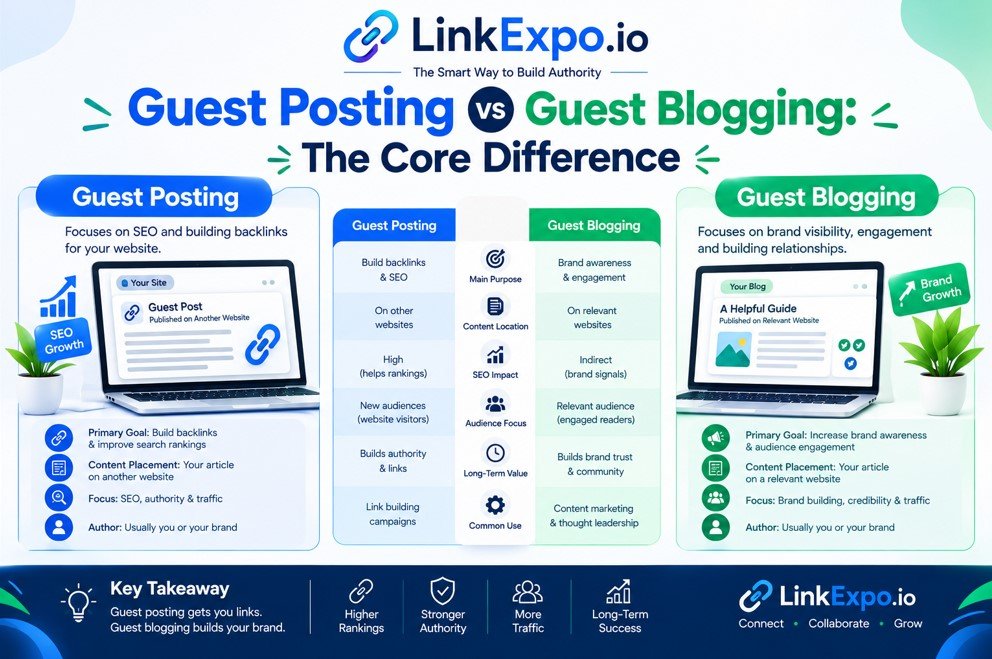
Here’s the simplest way to remember it: guest posting is about the link, guest blogging is about the relationship.
If your goal is to get a specific number of backlinks pointing to a specific page for SEO purposes, you’re guest posting — even if people casually call it guest blogging in conversation. If your goal is to become known as a trusted voice on someone else’s platform, and links are a nice side effect, that’s guest blogging.
Neither approach is wrong. They just solve different problems. A startup trying to rank a new landing page for a competitive keyword usually needs guest posting at scale. A consultant trying to build a personal brand in a specific industry usually needs guest blogging on two or three well-chosen sites.
Comparison Table
| Factor | Guest Posting | Guest Blogging |
| Primary goal | Backlinks / SEO | Audience & authority building |
| Relationship type | One-time transaction | Ongoing, recurring |
| Number of sites | Often many | Usually one or two |
| Time investment per site | Low | High |
| Backlink priority | Primary objective | Secondary benefit |
| Content ownership | Usually transferred to publisher | Often retains byline recognition |
| Best suited for | SEO campaigns, link building at scale | Personal branding, thought leadership |
| Typical channel | Marketplaces, outreach agencies | Direct pitching, editorial relationships |
| Speed to results | Faster — order and publish | Slower — trust builds over months |
Pros and Cons of Guest Posting
Guest posting works well for specific goals, but it isn’t free of trade-offs.
Pros
- Scalable. You can secure placements on dozens of sites in the time it would take to build one guest blogging relationship.
- Predictable. Pricing and turnaround are usually clear upfront, especially through a structured marketplace.
- Faster results. There’s no waiting period to “earn trust” — the transaction is straightforward.
- Easier to track. Since each placement is a discrete event, measuring backlinks gained per campaign is simple.
Cons
- Lower personal recognition. Readers on the publisher’s site rarely remember a one-time guest author.
- Quality varies. Not every site accepting guest posts maintains the same editorial standards.
- Risk of low-value links if sites aren’t properly vetted for real traffic and relevance, rather than just a high-looking authority score.
Pros and Cons of Guest Blogging
Guest blogging trades speed for depth.
Pros
- Builds real authority. Regular contributions make you a recognizable name in your niche.
- Stronger reader trust. Audiences associate you with the publication over time, not just a single article.
- Compounding backlinks. Every new post adds another link, often to different pages, without repeating the outreach process from scratch.
- Networking value. Ongoing relationships with editors often lead to more opportunities down the line.
Cons
- Slow to start. Earning a recurring slot usually requires proving yourself with a strong first post.
- Limited to fewer sites. You physically can’t maintain recurring relationships with dozens of publications.
- More content demand. Sustained, high-quality writing is required, not a single piece.
Which One Is Better for SEO?
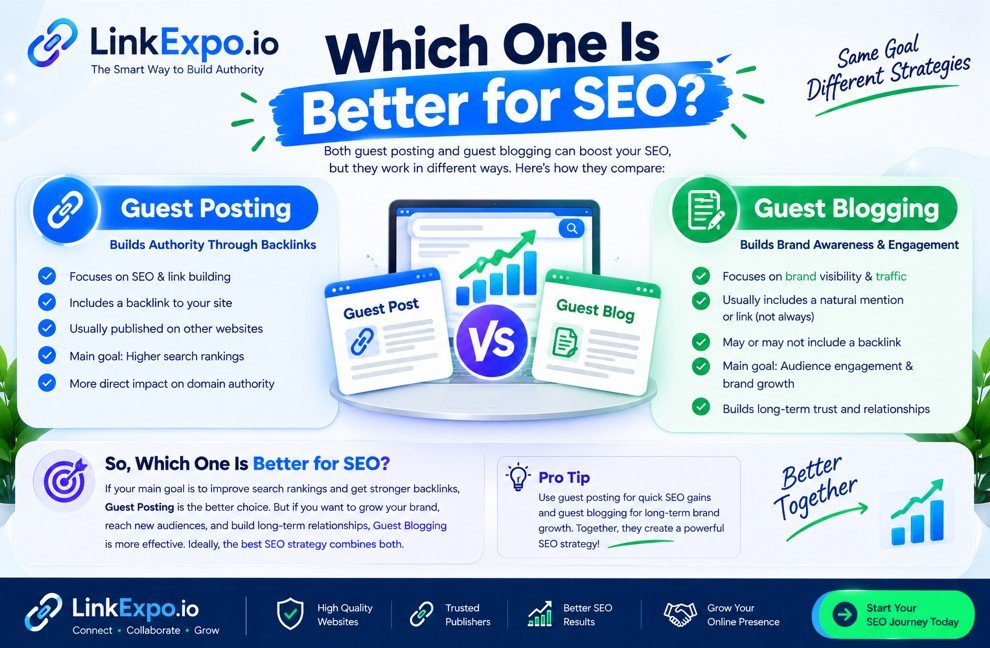
For pure link-building purposes, guest posting usually wins on efficiency. If your priority is earning backlinks to a specific page — say, a product page you’re trying to rank for a competitive keyword — placing content across several relevant, well-vetted sites will move the needle faster than cultivating one long-term relationship.
That said, quality still matters more than quantity. According to Google’s Search Essentials guidelines, links created purely to manipulate rankings, without providing real value to readers, fall under link spam policies and can be devalued or penalized. This applies to both guest posting and guest blogging equally — the label doesn’t protect a low-quality link.
The safest approach is choosing editorially reviewed placements on sites with real traffic and topical relevance, rather than chasing raw domain authority numbers. A site with modest metrics but genuine readers in your niche is often more valuable than a high-authority site with no real audience.
Here’s a practical way to think about it: imagine two sites both showing a Domain Authority of 40. One publishes three articles a week to an engaged mailing list of 20,000 readers in your exact industry. The other hasn’t updated in months and seems to exist mainly to sell guest post slots. Both might look identical on a metrics dashboard, but only one is likely to send real traffic, build genuine trust with search engines, and hold its value over time. Metrics are a starting filter, not a final answer.
Which One Is Better for Brand Building?

If the goal is recognition rather than rankings, guest blogging is the stronger choice. A single guest post rarely moves the needle on brand awareness — readers forget a one-off byline almost immediately. But a recurring column, published consistently on a respected industry site, builds familiarity.
This matters most for consultants, founders, and service providers whose business depends on being seen as a credible voice — not just for their website’s search ranking. In these cases, the backlink is a bonus. The real value is trust transferred from the publication to you.
How to Choose the Right Approach for Your Goal

Ask yourself three questions before deciding:
- Is my priority rankings or reputation? Rankings favor guest posting at scale. Reputation favors guest blogging with fewer, better-chosen sites.
- How much time can I realistically commit? Guest blogging demands ongoing content creation. Guest posting can be outsourced or managed through a marketplace with far less time investment.
- Do I need results quickly, or am I playing a longer game? Campaigns with a deadline — a product launch, a funding round, a seasonal push — usually need the speed of guest posting. Long-term brand plays can afford to wait for guest blogging relationships to mature.
Many experienced marketers use both. They run guest posting campaigns for steady link acquisition while also nurturing two or three guest blogging relationships on sites that matter most to their industry reputation.
Common Mistakes to Avoid
- Treating every placement as one-size-fits-all. Using a guest blogging strategy where you needed fast, scalable links wastes months. Using a guest posting mindset where you needed relationship-building burns bridges with editors who expected more investment.
- Ignoring site relevance for the sake of a link. A backlink from an unrelated site provides little SEO value and can even look unnatural to search engines.
- Overlooking anchor text variation. Repeating the exact same anchor text across many guest posts can look manipulative rather than natural.
- Skipping due diligence on publishers. Whether posting once or contributing regularly, verify real traffic and editorial standards before committing time or budget. A transparent marketplace that shows verified metrics upfront removes much of this guesswork.
- Forgetting to track results. Whichever approach you choose, measure referral traffic and ranking changes afterward — not just the number of links secured.
- Treating both strategies as “set and forget.” Even a guest posting campaign benefits from periodic review — checking that placed links are still live, still relevant, and still pointing to a page that exists. Links get removed, sites change ownership, and content gets deleted more often than most people expect.
Frequently Asked Questions
- Are guest posting and guest blogging the same thing? Not exactly. Guest posting is usually a one-time content exchange focused on backlinks. Guest blogging involves an ongoing contributor relationship focused on audience building, with backlinks as a secondary benefit.
- Which one is faster to see results from? Guest posting delivers faster results since it doesn’t require building trust with a publisher over time. Placements can go live within days through a structured marketplace.
- Can guest posting hurt my SEO? Only if done carelessly. Posting on irrelevant, low-quality, or spam-filled sites can hurt your site’s credibility and, in extreme cases, trigger a manual action from Google if the pattern looks manipulative. Choosing verified, relevant publishers with real editorial standards avoids this risk almost entirely.
- Is guest blogging better for backlinks than guest posting? Not necessarily. Guest posting often produces more total backlinks in less time since it isn’t limited to one or two ongoing relationships.
- How do I find sites that accept guest posts? You can pitch website owners directly through outreach, or use a guest post marketplace that already lists vetted, verified sites with clear pricing and metrics.
- Do I need to be a good writer to guest blog? Yes, more so than for a single guest post. Publishers granting a recurring slot expect consistent quality, since your name becomes associated with their brand over time.
- What metrics should I check before guest posting on a site? Look beyond Domain Authority alone. Real organic traffic, topical relevance to your niche, and editorial standards matter just as much, if not more.
- Is guest posting still effective for SEO in 2026? Yes, when done on relevant, editorially reviewed sites. Search engines continue to value contextual backlinks from real publications — what’s changed is that low-effort, mass-produced placements carry far less weight than they once did.
- Can I do both guest posting and guest blogging at the same time? Yes. Many marketers run guest posting campaigns for steady link growth while maintaining a smaller number of guest blogging relationships for brand authority.
- How much does guest posting typically cost? Pricing varies by site authority, niche, and traffic, generally ranging from modest rates on smaller sites to significantly more for established, high-traffic publications. Marketplaces often display transparent per-site pricing so you can compare options before ordering.
Conclusion
Guest posting and guest blogging aren’t competing strategies — they’re two different tools for two different goals. Guest posting gets you backlinks efficiently, at scale, with minimal ongoing commitment. Guest blogging builds recognition and trust with an audience over time, with links as a welcome side effect rather than the main prize.
The mistake most people make isn’t choosing the wrong one — it’s not realizing there’s a choice to make at all. Once you know which outcome you actually need, picking the right approach becomes much easier.
If backlinks and speed are the priority, a vetted marketplace where publishers and pricing are already transparent removes most of the guesswork. If long-term authority is the goal, treat guest blogging as relationship-building first and link building second — the backlinks will follow naturally once the relationship is real.
Whichever path fits your current goal, the underlying rule stays the same: value to the reader comes first. A backlink earned on the back of genuinely useful content will always outperform one squeezed out of a low-effort placement, regardless of which label you put on the strategy.