Do-Follow vs No-Follow Links in Guest Posting: The Complete 2026 Guide
If you’ve spent any time researching guest posts, you’ve probably run into a heated debate. Some sellers insist every link must be do-follow or it’s “worthless.” Others say that’s outdated thinking. Both sides have a point — and neither is telling you the whole story.
This guide breaks down exactly what do-follow and no-follow links are, how Google actually treats them in 2026, and which one makes sense for your specific campaign. No jargon, no fear-mongering — just what you need to buy (or sell) guest posts with confidence.
What Is a Do-Follow Link?
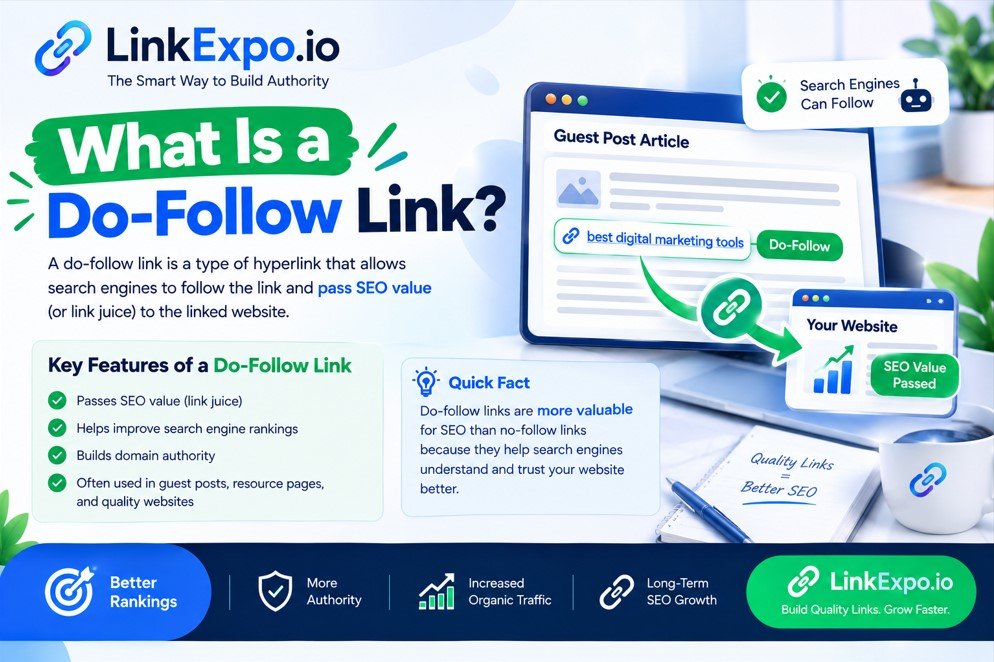
A do-follow link is simply a normal hyperlink with no special instructions attached. When you write <a href=”example.com”>click here</a>, that’s a do-follow link by default. There’s no extra code, no special attribute — it’s just how links work unless someone deliberately changes them.
Search engines treat do-follow links as a signal of trust. When Site A links to Site B without any restriction, Google reads that as Site A vouching for Site B’s content. Enough of these votes of confidence, from enough different trustworthy sites, and Google starts to see Site B as more authoritative.
This is the foundation of how backlinks have influenced rankings since Google’s earliest algorithms. A do-follow link passes what SEOs call “link equity” — a portion of the linking page’s authority — to the page it points to.
What Is a No-Follow Link?
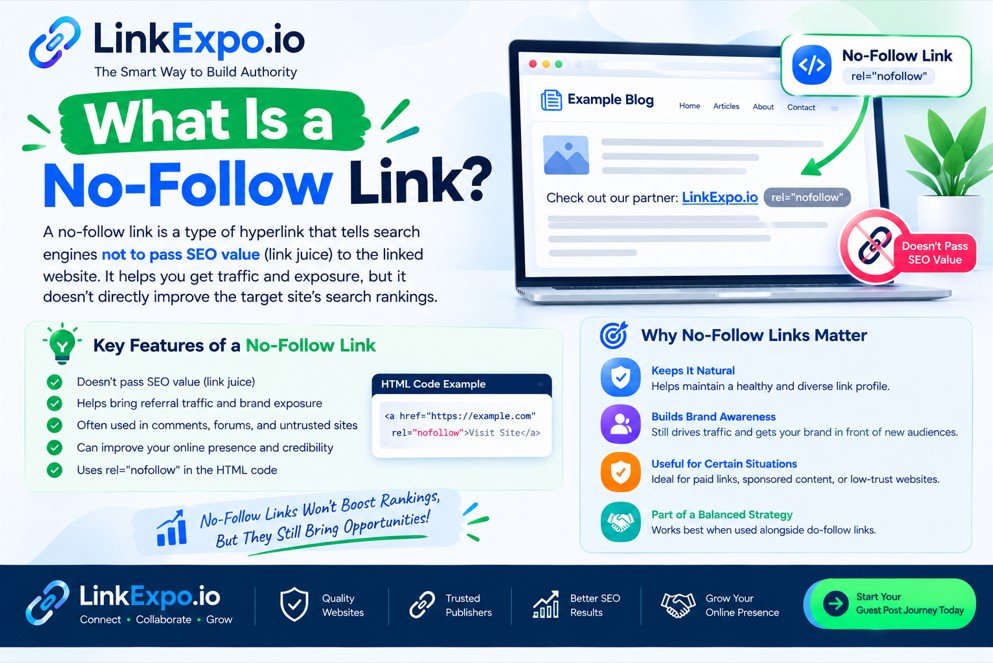
A no-follow link carries an extra piece of code: rel=”nofollow”. This attribute tells search engines that the site owner isn’t necessarily vouching for the destination, or doesn’t want to pass ranking credit through that specific link.
Google introduced the nofollow attribute back in 2005, originally as a way to fight comment spam. Site owners could let visitors leave links in blog comments without worrying that spammers would farm their site for free authority.
Since then, two related attributes joined the family:
- rel=”sponsored” — for paid links, ads, and affiliate placements
- rel=”ugc” — for user-generated content, like forum posts or comments
Together, these three attributes let publishers tell search engines exactly what kind of link they’re dealing with, rather than lumping everything into one blunt “nofollow” category.
The 2019 Update That Changed Everything
Here’s the part most guest posting guides get wrong, or leave out entirely.
In September 2019, Google announced a major shift. Nofollow stopped being a strict directive — a rule Google always obeys — and became a hint instead. Google now decides, on a case-by-case basis, whether to factor a nofollow link into ranking and crawling anyway.
In practice, this means:
- Google can still crawl and index pages linked with nofollow
- Google can still consider nofollow links as a ranking signal, at its own discretion
- The strict wall between “counts” and “doesn’t count” no longer exists
This doesn’t mean nofollow links are secretly just as powerful as do-follow ones. It means the difference is smaller and less predictable than the old SEO folklore suggests. A 2025 industry study examining link data across 1,000 domains found that do-follow and no-follow links correlated with visibility in AI-powered search results almost identically — a sign that modern search systems are looking well beyond a single HTML attribute to judge a page’s authority.
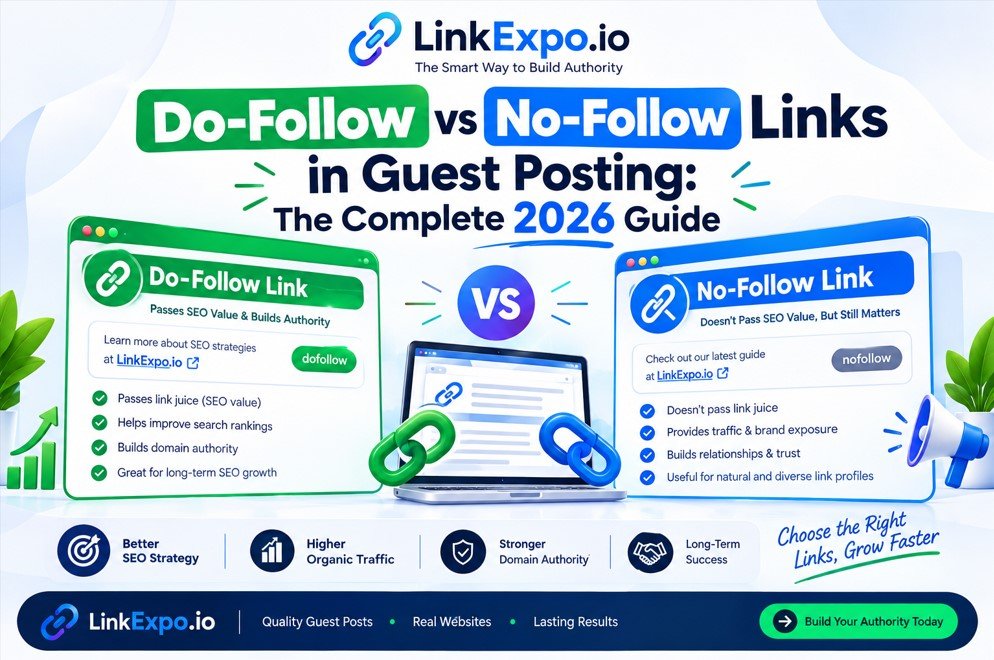
Do-Follow vs No-Follow: Side-by-Side Comparison
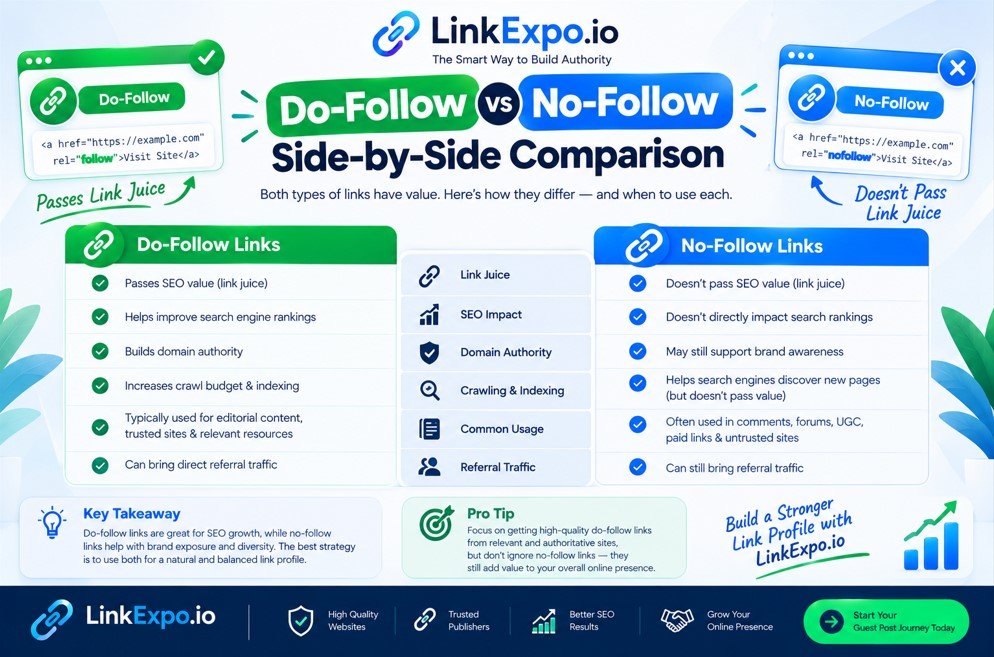
| Factor | Do-Follow | No-Follow |
| Passes link equity | Yes, by default | Treated as a hint, not guaranteed |
| Common use case | Editorial links, genuine recommendations | Paid links, comments, unverified sources |
| Google’s stance since 2020 | Full signal | May still be considered, at Google’s discretion |
| Ideal for guest posts | Yes, when editorially earned | Situational — see below |
| Risk if overused | Can look manipulative if unnatural | Low risk, safer for disclosure |
| Typical price on marketplaces | Higher | Lower |
| Best for | Building topical authority | Diversifying a natural link profile |
Why Guest Post Buyers Obsess Over Do-Follow Links
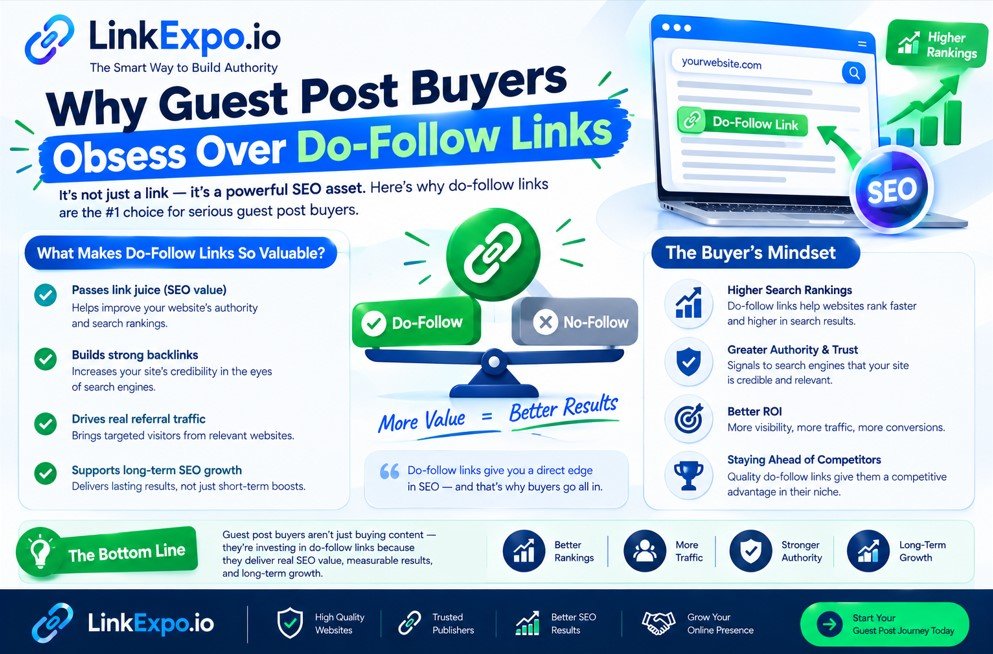
Do-follow links remain the more sought-after option, and there’s a legitimate reason for that beyond habit.
They’re still the clearest signal of editorial endorsement. When a publisher includes your link with no restriction, it reads as a genuine recommendation — not a disclosed ad. Google’s algorithms are built to reward exactly that kind of organic trust signal.
They historically correlate with ranking movement. Years of SEO case studies show a consistent (if not perfectly linear) relationship between quality do-follow backlinks and improved rankings for competitive keywords.
They’re what most link-building reports track. Tools like Ahrefs and Semrush prominently display do-follow vs no-follow ratios, which means agencies and in-house SEOs are trained to prioritize the metric — even if the underlying algorithm has grown more nuanced.
They fit naturally into an E-E-A-T strategy. Google’s quality guidelines emphasize experience, expertise, authoritativeness, and trust. A do-follow link from a genuinely relevant, well-established site acts as a small piece of third-party validation — one more signal that real experts in your field consider your content worth pointing to. A no-follow link can carry some of that same trust value in the eyes of a human reader, but it doesn’t translate into the same algorithmic authority signal.
None of this means a do-follow link is a magic ranking button. Context matters enormously: the linking site’s real traffic, topical relevance, and content quality all weigh heavier than the rel attribute alone.
Does a No-Follow Link Still Help Your SEO?
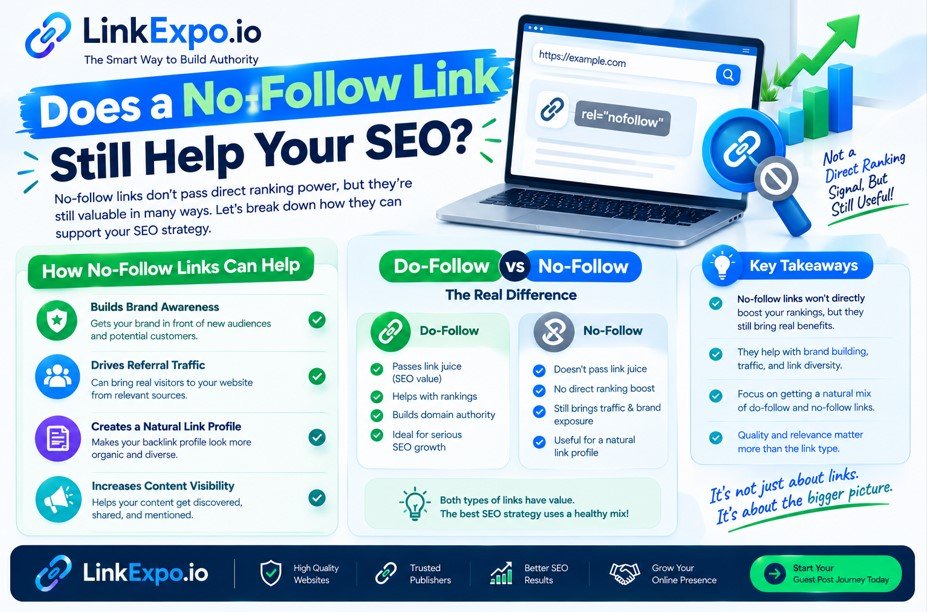
Yes — just not in the way people assume.
A no-follow link can still:
- Drive direct referral traffic. People click links regardless of what’s in the HTML.
- Build brand visibility and recognition. Repeated exposure across relevant sites builds familiarity, which search engines increasingly associate with trustworthiness.
- Contribute to a natural link profile. A backlink profile made up entirely of do-follow links from guest posts can actually look unnatural to Google. Real websites earn a mix of both.
- Occasionally still pass some ranking signal. Since nofollow is now a hint rather than a rule, Google may factor it in under certain conditions.
Think of a no-follow link less as “worthless” and more as “a different kind of asset.” It’s closer to digital PR than pure link building — valuable for visibility and trust, even without a guaranteed ranking boost.
Pros and Cons of Do-Follow Links
Pros:
- Passes link equity and topical relevance signals
- Strongest historical correlation with ranking improvement
- Signals genuine editorial endorsement
- What most competitor backlink audits will show you
Cons:
- Costs more on most guest post marketplaces
- Publishers are more selective about what they’ll do-follow
- A profile that’s 100% do-follow can look manipulated
- No guarantee of ranking impact on its own
Pros and Cons of No-Follow Links
Pros:
- Cheaper, making them useful for broader brand visibility campaigns
- Lower risk of looking like a manipulative link scheme
- Still drives real traffic and builds topical presence
- Helps diversify a link profile that’s too do-follow-heavy
Cons:
- Ranking impact is inconsistent and not guaranteed
- Rarely moves the needle for highly competitive keywords alone
- Some buyers feel they’re not getting SEO value for their spend
How to Check If a Guest Post Link Is Do-Follow
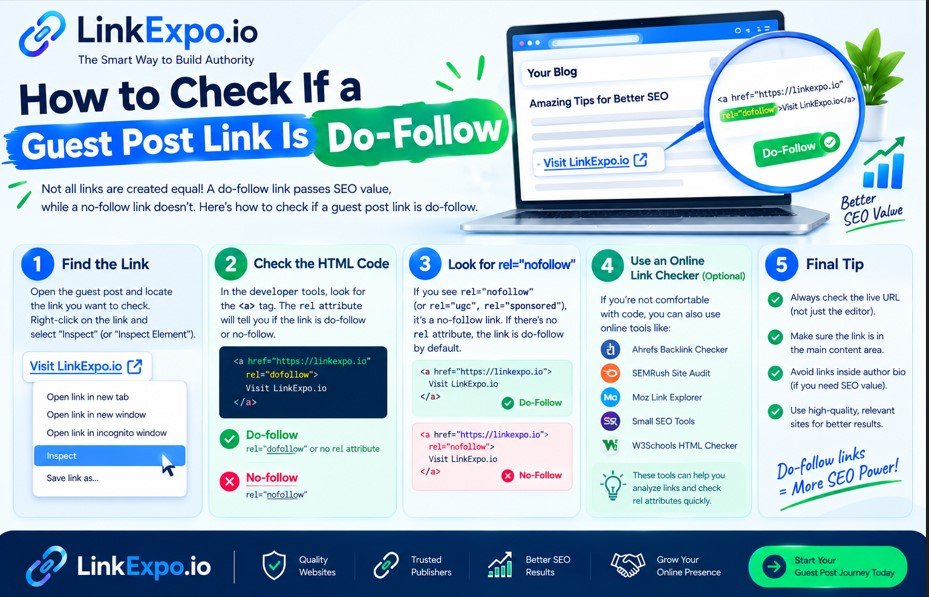
Before you pay for a placement, verify what you’re actually getting. Here’s how:
- Right-click the link and select “Inspect.” Look at the <a> tag in the code that opens.
- Check for rel=”nofollow”, rel=”sponsored”, or rel=”ugc”. If none of these appear, it’s a do-follow link.
- Use a browser extension. Tools like SEO Meta in 1 Click or MozBar highlight nofollow links directly on the page — no manual code-reading required.
- Cross-check with a backlink tool. Ahrefs or Semrush will classify the link type in their backlink reports once it’s indexed.
On LinkExpo, every listing states the link type upfront, so you know exactly what you’re ordering before you pay — no guessing, no inspecting code after the fact.
How to Build a Balanced Link Profile
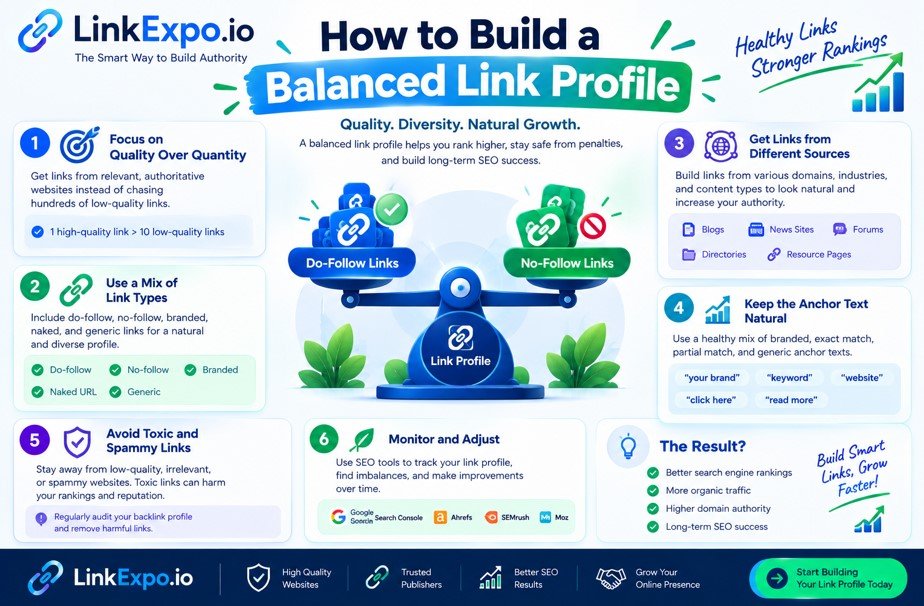
The healthiest backlink profiles rarely come from a single link type. A practical mix looks like:
- A majority of do-follow links from relevant, editorially strong sites
- Some no-follow links from high-traffic or high-authority sites, even without direct link equity
- A spread of anchor text — branded, generic, and exact-match, rather than the same keyword repeated everywhere
- Natural placement timing — links earned gradually, not all at once
If every single backlink you own is a perfectly optimized, exact-match-anchor, do-follow link, that pattern itself can raise flags. Real websites don’t earn links that uniformly.
A Simple Ratio to Aim For
There’s no official Google-sanctioned formula, but many experienced SEOs work toward roughly 70–80% do-follow and 20–30% no-follow as a rough, natural-looking baseline — adjusting based on your niche’s typical linking patterns. A brand-new site chasing an aggressive, all-do-follow strategy in its first few months is one of the more common patterns that draws unwanted algorithmic attention. Spacing out link acquisition over weeks and months, rather than buying dozens of links in a single week, also mirrors how organic link-earning naturally happens.
Red Flags When Buying “Guaranteed Do-Follow” Links
Be cautious of sellers who make these promises without backing them up:
- “100% do-follow, no exceptions, forever.” Publishers sometimes update their nofollow policies after the fact — a guarantee with no verification process is just a promise.
- No way to confirm link type before payment. You should be able to see this on the listing itself.
- Prices far below market rate. Extremely cheap do-follow links are often on low-quality or spammy sites that could do more harm than good.
- No transparency about the publishing site. If you can’t verify real traffic or relevance before ordering, you’re buying blind.
A well-run marketplace solves this by showing verified metrics — domain authority, real traffic, and link type — before you commit to an order, and by holding payment until the link is confirmed live and matches what was promised.
Frequently Asked Questions
Is a do-follow link always better than a no-follow link? Not always. Do-follow links generally carry more ranking potential, but a no-follow link from a highly relevant, high-traffic site can still be worth more than a do-follow link from an obscure, low-quality one.
Can Google penalize me for having too many do-follow guest post links? Google doesn’t penalize link type directly, but an unnatural pattern — like hundreds of exact-match-anchor do-follow links appearing suddenly — can trigger scrutiny under its link spam guidelines.
Do no-follow links help with traffic even if they don’t help rankings? Yes. A no-follow link is still a clickable link. Readers on the linking site can click through regardless of what’s in the HTML attribute.
How do I know if a guest post site changed a link from do-follow to no-follow later? Periodic backlink audits using tools like Ahrefs or Semrush will catch this. Some publishers do quietly nofollow links after a period of time, which is why ongoing monitoring matters.
Should beginners focus only on do-follow links? Not exclusively. A mix — with more weight toward do-follow — tends to look more natural and builds a more resilient link profile over time.
Is rel=”sponsored” the same as rel=”nofollow”? They’re related but distinct. Sponsored is specifically for paid or advertising links, while nofollow is a broader label. Google recommends using the most specific attribute that applies.
Do no-follow links pass any anchor text value? Anchor text is still visible to search engines even on no-follow links, though its weight in ranking calculations is far less certain than with do-follow links.
Why do some publishers charge more for do-follow links? Because do-follow links carry more perceived SEO value, and publishers who allow them are taking on more responsibility for who they’re linking to — that’s typically reflected in price.
Can a no-follow link turn into a do-follow link automatically? No. The change only happens if the publisher manually edits the HTML. It won’t happen on its own.
Where can I see whether a guest post listing is do-follow before I order? On LinkExpo’s browse page, the link type is listed directly on every site card, so this is visible before you place an order — not something you have to inspect afterward.
Conclusion
The do-follow versus no-follow debate isn’t as black-and-white as older SEO advice suggests. Do-follow links still carry more weight for building direct ranking authority, and they remain the better default choice for most link-building campaigns. But no-follow links aren’t worthless — they add balance, visibility, and a more natural footprint to your overall backlink profile.
The real mistake isn’t choosing the “wrong” link type. It’s buying blind — not knowing what you’re getting, from whom, or whether the site is even worth linking from in the first place.
Whichever type fits your strategy, work with sources that show you the details upfront: real traffic, real authority, and a clear link type, before any money changes hands. That transparency matters more than any single HTML attribute ever will.
Ready to see verified guest post listings with the link type shown on every card? Browse live sites on LinkExpo and compare your options before you order.
Suggested external references to link out to when publishing:
- Google Search Central’s official documentation on qualifying outbound links (search “Google qualify outbound links” for the current URL)
- Google’s Search Central Blog post announcing the nofollow, sponsored, and ugc attributes (September 2019)